
 There’s a little phrase people use all the time that sounds harmless on the surface:
“Because I know you.”
Most of us have said it. Most of us have heard it.
But lately, I’ve been thinking about how differently those words can land depending on what comes before them.
There’s a big difference between:
“You’ll get that project finished, because I know you.”
and
“I put the money in your purse, because I know you.”
One feels supportive.
The other feels like a quiet criticism wrapped in familiarity.
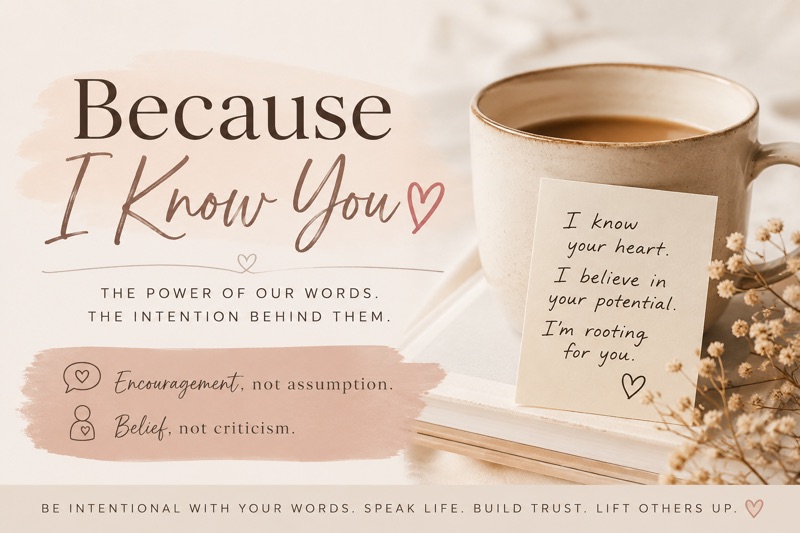
The phrase “because I know you” should mean:
“I understand your heart.”
“I believe in you.”
“I trust your character.”
Instead, it sometimes gets used to point out what someone lacks.
- “I cleaned the bathroom because I know you.”
- “I reminded you because I know you.”
- “I handled it because I know you.”
What’s really being said underneath those statements is often:
“You’d forget.”
“You wouldn’t finish.”
“You can’t be counted on.”
And maybe none of that is intended cruelly. In fact, it’s often said casually by people who genuinely love us. But intention and impact are not always the same thing.
Knowing someone should not become a license to define their weaknesses for them.
I think the most beautiful use of “because I know you” is when it speaks life into someone instead of limitation.
- “You’ll figure it out, because I know you.”
- “You’ll make everyone feel welcome, because I know you.”
- “You’ll keep going, because I know you.”
- “You’ll do something beautiful with this, because I know you.”
That kind of knowing feels different.
It feels like being seen instead of being managed.
And honestly, this whole thought has made me stop and pay attention to how I use this phrase too. I know I’ve probably said it in ways I never meant to sound hurtful. But now I want to be more intentional with it.
I want “because I know you” to sound like confidence, not criticism.
Like encouragement, not assumption.
I want the people I love to feel known for their strengths, their kindness, their resilience, and the beautiful things that make them who they are — not simply for the things they forget or struggle with.
Maybe the real question is this:
When we say “I know you,” are we speaking from belief… or from assumption?
Because the people we love deserve to feel seen in a way that lifts them up.
And honestly, sometimes the smallest phrases carry the heaviest meanings.

No comments:
Post a Comment